

Cloud computing is one of the fastest-paced emerging fields in the revolutionary IT world, and Microsoft Azure stands out as one of the top public cloud providers. In recent years, Microsoft Azure has observed some of the fastest-growing adoptions by organizations worldwide. Considering the ever-increasing adoption of Azure, it is fair to say that Microsoft Azure looms as a powerhouse, providing a robust platform for businesses to innovate, scale, and thrive. This also fueled the demand for aspiring professionals. Understanding the Azure certification path is vital if you’re a novice looking to enhance your skills or a seasoned expert seeking validation of your Azure expertise.
In this comprehensive guide, we’ll navigate through the various Azure certification levels and explore pathways to elevate your career to new heights. Join us as we unravel the intricacies of Azure certifications, empowering you to make informed decisions and embark on a journey toward mastering the cloud.
What Are Microsoft Azure Certifications?
Microsoft Azure Certifications are universally recognized credentials that signify an individual’s ability to utilize Microsoft’s Azure cloud platform. These certifications are designed for individuals with varying experience levels, ranging from beginner to professional. Currently, Microsoft Azure offers 22 certifications, categorized into three levels: Beginner, Intermediate, and Advanced. The table below distinguishes the certifications, along with the levels to which they belong.
Read more: How To Crack Microsoft Azure Certification?
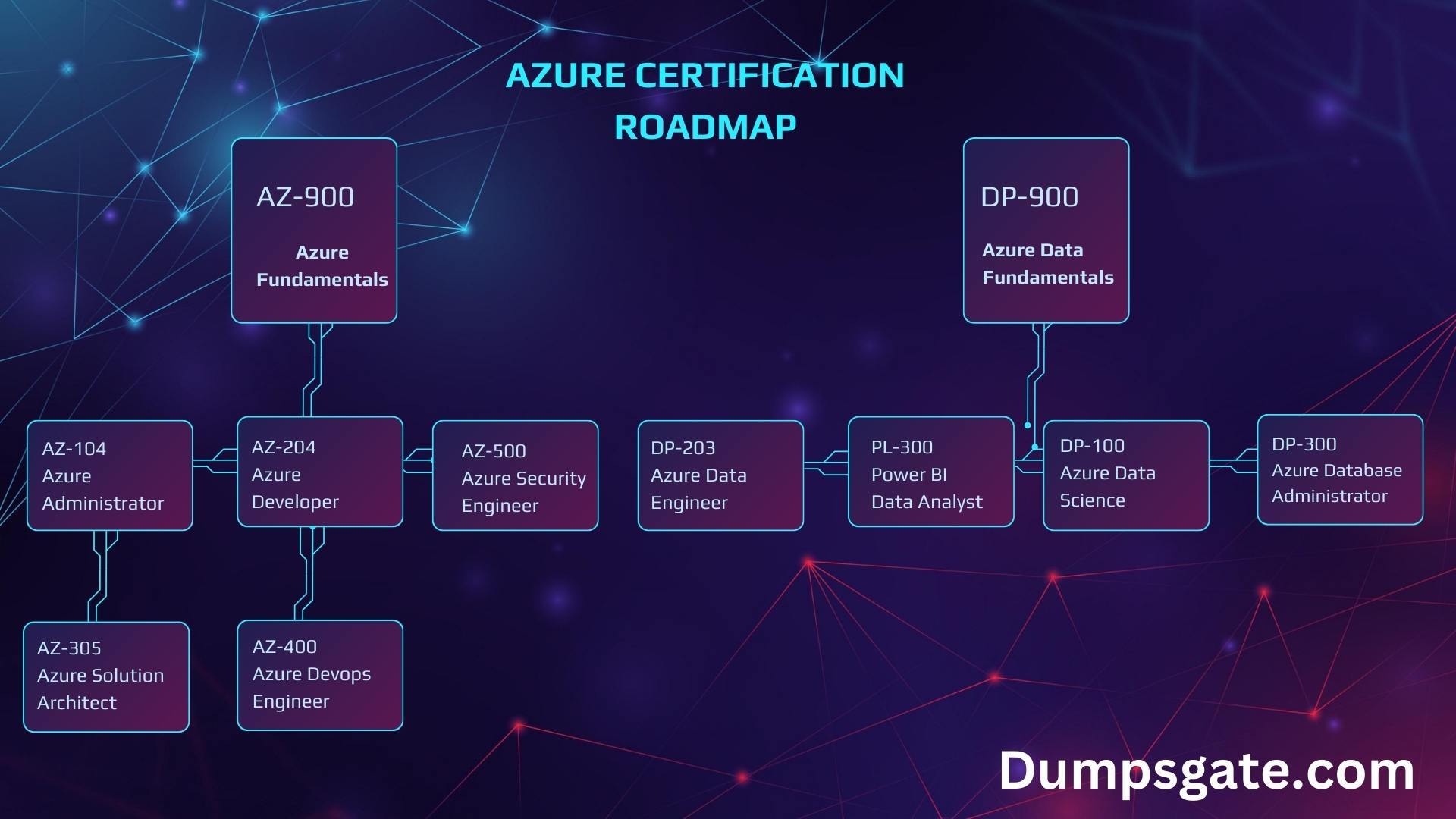
What Are The Azure Certification Paths?
Microsoft provides the candidates with various role-based paths for the following careers.
1. Developers— AZ-204, AI-102, AZ-400
For starting a career as a developer, the Azure Developer Associate Certification is the right choice. Since this certification signifies an individual’s expertise in designing, building, and maintaining cloud applications within Azure, candidates can also obtain AI-102 and AZ-400 as potentially advanced options.
2. DevOps Engineer– AZ-104, AZ-204, AZ-400

To become a DevOps Engineer, you will have two choices as a beginner: you can either earn the Azure Administrator Associate (AZ-104) or Azure Developer Associate (AZ-204) certification and then take Designing and Implementing Microsoft DevOps Solutions (AZ-400).
Explore Further: How to Earn the Title of Microsoft Azure DevOps Expert in 2026
3. Administrators – AZ-900, AZ-104, AZ-140
The Azure certification path for administrators starts with obtaining the Azure Fundamentals (AZ-900) for building a foundational knowledge, and then, for the intermediate level, or for validation of knowledge, candidates can pursue Microsoft Certified: Azure Administrator Associate (AZ-104), which helps in validation of core administration skills, or you can even pursue Microsoft Certified: Azure Virtual Desktop Specialty (AZ-140).
Explore the earring potential of AZ-900 certified: Discover the Worth of AZ-900 Certification to Maximize Your IT Career in 2026
Security Engineers— AZ-900, SC-900, AZ-500
For those looking to become a security engineer, pursuing the Microsoft Certified: Azure Security Engineer Associate (AZ-500) certification is the right choice. However, since it is an expert-level certification, it is recommended to pursue AZ-900 first to gain a basic understanding of the cloud platform, or the Microsoft Certified: Security, Compliance, and Identity Fundamentals (SC-900) for more foundational security knowledge.
To know about the SC-900 exam, explore: SC-900 EXAM- A COMPREHENSIVE GUIDE IN 2025
Data and AI Professionals—AI-900/DP-900, DP-100/ AI-102, DP-300
Azure certification path for data and AI professionals begins with obtaining the AI-900 (Azure AI Fundamentals) and DP-900 (Azure Data Fundamentals) as a foundational level certification, then can continue with pursuing DP-100 (Azure Data Scientist Associate) or AI-102 (Azure AI Engineer Associate), and can continue with obtaining DP-300 (Azure Database Administrator Associate) for specialization.
Explore Insights on: Microsoft Azure AI Fundamentals – AI-900 Certification Overview
Solution Architects– AZ-900/AZ-104, AZ-305

The certification path for Azure Solution Architect begins with obtaining a foundational level credential that can be either AZ-900: Azure Fundamentals certification or the Microsoft Certified: Azure Administrator Associate (AZ-104) certification as a foundational level, as well as a prerequisite for the AZ-305: Designing Microsoft Azure Infrastructure Solutions, which is an advanced-level credential.
Insights on Azure Solution Architect Career: Azure Solution Architect Salary Based on Jobs, Location and Experience
AI Engineer– AI-900, AI-102
It is recommended to obtain the Microsoft Certified: Azure AI Fundamentals (AI-900) certification as a foundational level, following the associate-level certification, Microsoft Certified: Azure AI Engineer Associate (AI-102), which is also the core certification for Azure AI Engineers.
Click here: How To Become an AI Engineer In 2026
Which Is The Most Suitable Azure Certification To Avail, While Starting My Career?
When starting a career in cloud computing, it is recommended to obtain multiple certifications, including AI-900, AZ-900, SC-900, and DP-900. Just in case you are thinking of switching careers and coming to cloud computing, these credentials are a great choice.
Choosing Azure certifications is worth the time and money due to their high demand and budget-friendly pricing.
Delve into the details of: A Guide to Azure Certification Path to Explore Various Certifications Options
An Overview Of Azure Certifications Along With Their Prices
The cost of getting an Azure certification isn’t only related to exam fees; other costs also add to it. An overall price depends on the exam fee, prep resources, practice test, and exam retake fee (if any). The exam cost of Azure certification varies with the certification level and geographical location. The fundamental level Azure certification costs $100, while the associate and expert level costs $165. The table below provides a detailed overview of Azure certifications, along with their associated exam costs.
Azure Certifications | Exam Code | Exam Cost |
Azure Fundamentals | AZ-900 | USD 99 |
AI Fundamentals | AI-900 | |
Azure Data Fundamentals | DP-900 | |
Microsoft Certified: Security, Compliance, and Identity Fundamentals | SC-900 | |
Azure Administrator Associate | AZ-104 | USD 165 |
Azure AI Engineer Associate | AZ-102 | |
Azure Developer Associate | AZ-204 | |
Azure Security Engineer Associate | AZ-500 | |
Azure Database Administrator | DP-300 | |
Azure Data Scientist Associate | DP-100 | |
Microsoft Certified: Azure Cosmos DB Developer Specialty | DP-420 | |
Microsoft Certified: Azure Network Engineer Associate | AZ-700 | |
Microsoft Certified: Azure Virtual Desktop Specialty | AZ-140 | |
Microsoft Certified: Azure for SAP Workloads Specialty | AZ-120 | |
Microsoft Certified: Identity and Access Administrator Associate | SC-300 | |
Microsoft Certified: Security Operations Analyst Associate | SC-200 | |
Azure Solution Architect | AZ-305 | |
Azure DevOps | AZ-400 | |
Microsoft Certified: Power Platform Solution Architect Expert | PL-600 |
Dig into: The Official Guide to All Microsoft Certification Prerequisites (Updated 2026)
Are Azure Certifications Worth It?
A career in cloud computing is highly sought after, which is why Azure certifications are in high demand. According to a report by Flexera, Azure is considered the most demanding among most cloud providers.
Obtaining Azure certifications not only boosts your career within cloud computing but also makes you quite competitive among your peers due to your validation of skills. According to ZipRecruiter, the average salary of an Azure-certified professional at the fundamental level is $121,500 in the United States. Whereas people pursuing associate-level or advanced-level certification tend to earn more.
Benefits of Role-Based Microsoft Azure Certifications
Microsoft Azure certification offers several role-based credentials at various levels to enhance your cloud career and provide a breakthrough in this domain. The certifications build your expertise in a wide array of Azure services and validate the skills and knowledge that certain certifications demand. These certifications emerged as the pivotal gateway to embark on an exciting career in the trendiest domain of cloud computing.
The Microsoft certification also helps you speed up the ever-evolving technological landscape of cloud computing and keep pace with evolving roles, enabling aspirants to remain competitive as technology continues to change rapidly. These certifications also help you grow in your role by demonstrating the potential skills required to be effective in job roles important to organizations.
Explore the career in Azure: Highest Paying Azure Certifications for 6-Figure Salaries
Bottom-line
Microsoft Azure has emerged as one of the leading cloud providers in the industry since its inception. Considering the demand and rush to opt for Azure cloud, Microsoft Azure offers several role-based certifications for aspiring professionals to keep pace with the latest technological advancements. The blog has provided you with valuable insights into the Azure certification path, making it easier for you to navigate the certification levels and explore pathways that support your career goals. So, give it a read and make a way to initiate your Azure career!
Frequently Asked Questions
What are the path levels of Azure certification?
The Azure certifications come at four levels such as fundamental, associate, expert, and specialty. All the certifications and levels build your skills relevant to a particular job role and level.
Do I need AZ 900 before AZ 104?
Well, there are no such prerequisites for taking AZ-900 before AZ-104 but it is recommended. It would be better to take AZ-900 first as it builds a strong fundamental knowledge and understanding of cloud computing and Microsoft Azure experience which will help you gain the AZ-104 certification easily.
Which Azure certification is best for beginners?
While the best certification significantly depends on your career goals and the one that enhances your previous experience, AZ-900 is considered one of the most basic and best Azure certifications. The certification validates your proficiency in Microsoft Azure and also enables you to get associate and expert-level certifications.
Which is better: AZ-104 or AZ-204?
Both are highly acquired certifications from Microsoft. Both exams are designed to assess your expertise in various domains of Azure technology and framework, and provide you with a pathway to earn professional-level certification. As both certifications are good choices, there is no ranking, and the choice between AZ-104 and AZ-204 will depend on your goals, career aspirations, and the job you’re interested in pursuing.
Article Sources
- Flexera. “State of the Cloud Report, https://resources.flexera.com/web/pdf/Flexera-State-of-the-Cloud-Report-2022.pdf.” Accessed in October 2025.
- ZipRecruiter, “Azure Fundamentals Salary, https://www.ziprecruiter.com/Salaries/Azure-Fundamentals-Salary#Yearly.” Accessed in October 2025.


