

In the world of finance, the right certification can truly unlock opportunities and transform your career. Two of the most respected finance certifications in the industry are the CFA (Chartered Financial Analyst) and CPA (Certified Public Accountant) and often seen as benchmarks of expertise. But how do you know which one suits your goals? While both are prestigious, they lead to distinct career paths, each with its own set of challenges and rewards.
Whether you’re looking to become a top-tier financial analyst or excel in accounting and auditing, understanding the key differences between CFA vs CPA is essential. This guide has been crafted specifically to help you navigate the pros and cons of each, so you can make an informed decision and choose the certification that aligns with your ambitions.
What is the CFA Certification?
The Chartered Financial Analyst (CFA) certification is globally recognized as the gold standard for professionals aiming to deepen their expertise in investment management, financial analysis, and portfolio strategy. Managed by the CFA Institute, this certification is particularly popular among individuals seeking roles in asset management, equity research, and investment banking. It has a rigorous certification program requiring individuals to clear 3 levels in order to be awarded this certification.
What is the CPA Certification?
The Certified Public Accountant (CPA) certification is a highly esteemed qualification in the accounting profession. Regulated by the American Institute of Certified Public Accountants (AICPA), this certification is essential for anyone looking to establish a career in accounting, auditing, or tax advisory services. While the CPA designation is primarily recognized in the United States, it is also gaining traction internationally, particularly as businesses expand and seek professionals with a strong accounting background. Hence, it can be a valuable credential to help aspiring finance individuals boost their careers and validate a higher level of knowledge and expertise in the field.
CFA vs CPA: Key Differences
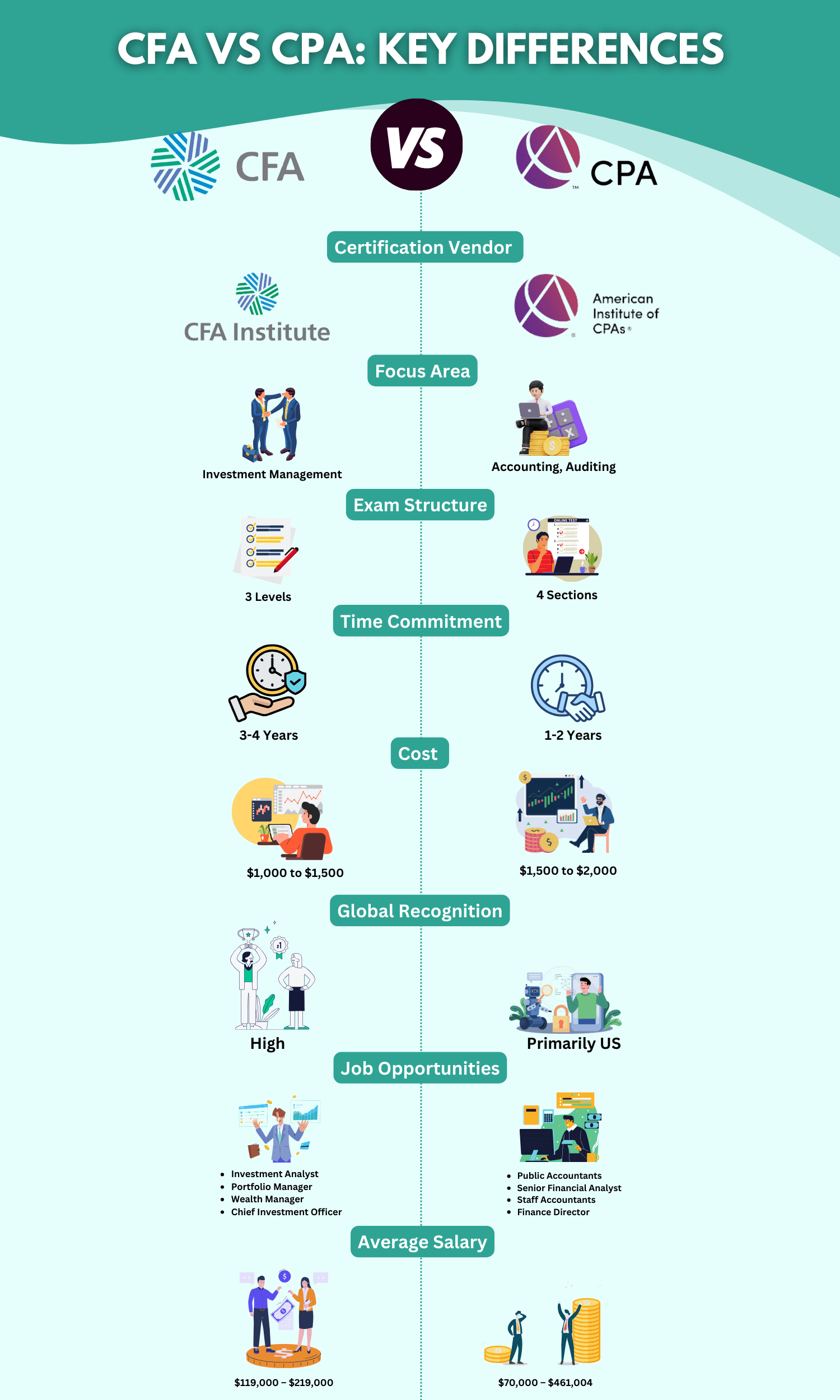
When it comes to choosing between the CFA and CPA certifications, understanding their fundamental differences is absolutely crucial. While highly recognized in the finance industry, both certifications offer distinct paths and opportunities, making them suitable for different career aspirations. Here’s a closer look at how they stack up against each other.
Exam Structure
Both the CFA and the CPA exams have different exam structures so let’s take a look at how your exam experiences may vary when taking either of these certification.
➡ CFA
The CFA exam consists of three levels, with each level requiring a deep understanding of complex financial concepts. Candidates must pass one level before progressing to the next, making it a lengthy process that can take several years to complete. Here is an overview of basic exam structure details.
Exam Level | Level I | Level II | Level III |
Exam Format | Multiple Choice Questions (MCQ’s) | Vignette-supported Multiple Choice Questions (MCQ’s) | Vignette-supported essay & Multiple Choice Questions (MCQ’s) |
Total Sessions | 2 Sessions Per Level | Add New | Add New |
Number Of Questions | 180 (90 MCQs for each session) | 22 items for Vignette-supported including 88 MCQs | 11-item sets & 11 essay sets for 12 points each (6 Items sets & 5 Essay sets or 5 items set & 6 Essay sets) |
Exam Duration | 4 hours & 30 minutes (Splits equally for 2 hours & 15 minutes for each session ) | 4 hours & 24 minutes (Splits equally for 2 hours & 12 minutes for each session) | 4 hours & 24 minutes (Splits equally for 2 hours & 12 minutes for each session) |
Passing Score | 41% | 45% | 52% |
Exam Delivery | Online Proctored Testing (OPT) | Online Proctored Testing (OPT) | Add New |
Read More: FMVA Certification
➡ CPA
The CPA exam, on the other hand, consists of four sections that can be taken in any order. While the content is challenging, candidates have the flexibility to schedule their exams according to their readiness, allowing them to spread their preparation over a shorter time frame. Here is the overall CPA exam structure.
Exam Format | Multiple-Choice Questions (MCQs) and Task-Based Simulations (TBS) | Add New |
Number of Questions | 200 MCQs | 22 TBS |
Competition Time | 18 months | 18 months |
Time Period for Exam | 4 hours | Add New |
Passing Marks | 75 (per section) | 75 (per section) |
Explore More: CCP Certification
Topic Covered
One of the more significant differences between CFA and CPA lies in the areas they target.
➡ CFA
The CFA program primarily emphasizes investment analysis, portfolio management, and financial markets. The curriculum covers topics like equity investments, fixed income, and derivatives, aiming to develop a comprehensive understanding of financial instruments and market dynamics. Candidates will be tested on the same domains, however, the weightage of each domain being tested varies depending on the level. It is important to note that you can only proceed to the new level once you have passed your current one. Here is a more comprehensive look.
Level I | Add New | Level II | Add New | Level III | Add New |
Level I | Level I | Level II | Level II | Level III | Level III |
Topics | Weightage | Topics | Weightage | Topics | Weightage |
Ethical & Professional Standards | 15-20% | Ethical & Professional Standards | 15-20% | Portfolio Management & Wealth Planning | 30-35% |
Quantitative Methods | 6-9% | Quantitative Methods | 5-10% | Ethical & Professional Standards | 10-15% |
Economics | 6-9% | Economics | 5-10% | Economics | 5-10% |
Financial Statement Analysis | 11-14% | Financial Statement Analysis | 10-15% | Equity Investments | 10-15% |
Corporate Issuers | 6-9% | Corporate Issuers | 6-9% | Fixed Income | 15-20% |
Portfolio Managemen | 8-12% | Equity Investments | 10-15% | Alternative Investments | 5-10% |
Equity Investments | 11-14% | Fixed Income | 10-15% | Derivatives | Derivatives |
Fixed Income | 11-14% | Derivatives | 5-10% | Portfolio Management & Wealth Planning are segregated into two different sub-groups named:
| Add New |
Derivatives | 5-8% | Alternative Investments | 5-10% | Add New | Add New |
Alternative Investments | 7-10% | Portfolio Management & Wealth Planning | 10-15% | Add New | *Portfolio Management & Wealth Planning are segregated into two different sub-groups named: Private Wealth; & Institutional Investing (15 - 20%) Asset Allocation; Trading; Performance Evaluation; and Investment Manager Selection (10%-20%) |
➡ CPA
In contrast, the CPA certification focuses on accounting, auditing, and taxation. It prepares professionals for roles in public accounting, internal auditing, and corporate finance. The curriculum includes financial reporting, tax regulations, auditing standards, and ethical considerations, ensuring that CPAs are well-equipped to handle financial records and compliance requirements. Here is a more detailed look.
Core Section
Auditing & Attestation (AUD)
| Financial Accounting & Reporting (FAR)
| ||||||||||||||||||
Taxation and Regulation (REG)
|
Discipline Section
Business Analytics & Reporting (BAR)
| Information Systems & Controls (ISC)
| ||||||||||||||||
Tax Compliance & Planning (TCP)
|
Time Commitment
In terms of time commitment.
➡ CFA
Completing the CFA certification can take 3-4 years due to the requirement of passing three levels, along with the recommended study hours for each level.
➡ CPA
Most candidates can complete the CPA certification in 1-2 years, depending on their prior education and the time they dedicate to studying for each section.
Global Recognition
Lastly, both certifications have global recognition, but their geographical appeal differs. The CFA is widely recognized in international financial markets, making it a valuable asset for professionals looking to work in investment management globally. On the other hand, the CPA is primarily recognized in the United States, and its relevance is growing internationally, particularly in markets that value robust accounting practices.
Eligibility Criteria for CFA and CPA
Understanding the eligibility requirements for both the CFA and CPA certifications is essential for anyone considering a career in finance or accounting. Each certification has its own set of criteria that candidates must meet to sit for the exams.
➡ CFA Eligibility Criteria
To qualify for the CFA program, candidates must meet the following requirements.
1. Educational Background
A bachelor’s degree or its equivalent is required. However, candidates can also apply if they are in the final year of their undergraduate program. This flexibility allows students nearing graduation to start their CFA journey early.
2. Professional Experience
Candidates must have at least four years of professional work experience in a field related to investment decision-making. This can include roles in investment analysis, financial advisory, or portfolio management.
3. Commitment to Ethics
All candidates must agree to adhere to the CFA Institute’s Code of Ethics and Standards of Professional Conduct, which emphasizes integrity and professionalism in the investment industry.
➡ CPA Eligibility Criteria
For the CPA certification, AICPA requires candidates to meet several requirements, which can vary by state in the U.S. Here are the general criteria.
1. Educational Requirements:
Candidates must have completed a bachelor’s degree, typically with a concentration in accounting or a related field. Most states require candidates to have 150 semester hours of college coursework, which is more than the typical 120 hours for a bachelor’s degree. This often means pursuing a master’s degree or additional coursework.
2. Examination:
Candidates must pass the Uniform CPA Examination, which consists of the four sections previously mentioned. Each section tests specific knowledge areas and must be completed within an 18-month timeframe after passing the first section.
3. Experience:
Most states require candidates to have 1-2 years of relevant work experience in accounting, which must be supervised by a licensed CPA. This hands-on experience is vital for understanding the practical application of accounting principles.
Cost and Investment: CFA vs CPA
When considering professional certifications like the CFA and CPA, it’s essential to factor in the overall costs associated with each path. From exam fees to study materials and additional expenses, understanding the financial commitment is crucial for making an informed decision.
CFA Certification Cost Breakdown
The total cost of obtaining a CFA certification can vary depending on various factors, such as study materials and exam registration fees. Here’s a breakdown of the potential costs.
Features | Early Registration Fee | Add New | Standard Registration Fee | Add New |
Exam Cost | $990 (USD) For Level I & II | $1,090 (USD) For Level III | $1,290 For Level I & II | $1,390 For Level III |
Registration Timings | 6th Nov 2024 till 29th Jan 2025 | 6th Nov 2024 till 29th Jan 2025 | 30th Jan 2025 till 6th May 2025 | 30th Jan 2025 till 6th May 2025 |
Duration | 18 - 24 Months per level | Add New | Add New | Add New |
Enrollment Fee | $350 (USD) | Add New | Add New | Add New |
Rescheduling Cost | $250 (USD) | Add New | Add New | Add New |
➡ Enrollment Fee
The CFA Institute charges a one-time enrollment fee of approximately $350. Additionally, each level of the CFA exam has its registration fee, which ranges from $1,000 to $1,500, depending on how early you register. If you register early, you get to pay USD 990 for Level I and Level II, whereas, with standard registration, you will have to pay $1,250 USD for both levels. The early registration for Level III is $1,090 USD but if you’re doing standard registration, you will be required to pay $1,390 USD.
➡ Study Materials:
Preparing for the CFA exams often requires purchasing study materials, which can range from $300 to $1,000. Many candidates opt for review courses or prep classes, which can add to the total cost.
➡ Rescheduling Fee:
Candidates are also required to pay an additional rescheduling fee of $250 USD if they have to retake their exam.
➡ Additional Costs:
There may be other expenses, such as travel for exam locations, which can vary based on your geographical area. Overall, candidates can expect to invest $2,500 to $5,000 in total for the CFA certification.
➡ Time Investment:
The CFA program also requires a significant time commitment, with candidates typically dedicating 300 to 400 hours of study for each level. This means you should also consider the potential opportunity cost of your time.
Look Further: Certified Cost Professional (CCP) Certification Guide: Salary, Jobs And How To Earn One
CPA Certification Cost Breakdown
The costs associated with the CPA certification can also add up, though they differ significantly from the CFA. Here’s a breakdown of the expected expenses.
On-site Fee | Live Online | |
AICPA Members | $1,795 | $1,595 |
Non-Members | $1,995 | $1,795 |
PCPS Firms & CITP or CGMA Credential Holders | $1,695 | $1,495 |
Group of 2 - 5 | $100 Per Person Automatically | Add New |
Group of 6 or More | $200 Per Person Automatically | Add New |
Pack 7 Option | $300 Per Registration | Add New |
➡ Exam Fees:
The total cost to take the CPA exam typically ranges from $1,500 to $2,000, depending on the state in which you are applying. Each of the four sections has its own fee, usually around $200 to $300.
➡ Educational Costs:
Given the requirement for 150 semester hours, many candidates opt for additional coursework or a master’s degree, which can cost anywhere from $10,000 to $50,000 depending on the institution.
➡ Study Materials:
Similar to the CFA, candidates often invest in study materials and review courses for the CPA exam, which can range from $200 to $1,500.
➡ Additional Costs:
There may also be costs associated with licensing and continuing education requirements, which vary by state. The total investment for CPA certification can range from $5,000 to $10,000 or more, especially when considering the educational prerequisites.
➡ Time Investment:
Candidates typically dedicate 300 to 400 hours of study for the CPA exam, similar to the CFA, but with the added flexibility of taking sections in any order.
Job Opportunities: CFA vs CPA
Choosing between the CFA and CPA certifications not only depends on your interests but also significantly impacts your career trajectory. Each certification opens doors to different roles within the finance and accounting sectors, offering unique opportunities for growth and specialization.
Job Roles with CFA Certification
The CFA certification is particularly valued in the investment and finance sectors. Here are some common career paths for CFA holders:
➡ Investment Analyst
CFA credential holders often start their careers as investment analysts, where they conduct research, analyze financial data, and make recommendations to buy, sell, or hold securities. This role requires a deep understanding of financial markets and instruments.
➡ Portfolio Manager
With experience, many CFA professionals move into portfolio management, where they are responsible for making investment decisions and managing client portfolios. This role involves strategic planning and the ability to assess market trends and risks.
➡ Risk Manager
Risk management has become increasingly crucial in finance. CFA charter holders can pursue careers as risk managers, analyzing and mitigating financial risks associated with investments and corporate finance.
➡ Financial Advisor
Those with a CFA certification may also become financial advisors, helping individuals and organizations develop investment strategies and manage their wealth.
➡ Equity Research Analyst
This role involves evaluating companies and industries to provide recommendations on stock investments. CFA-certified professionals are well-prepared for this analytical position, which requires strong quantitative skills.
Click here: Best Risk Management Tools and Techniques for 2026
Job Roles With CPA Certification
The CPA certification is essential for individuals seeking careers in accounting and finance. Here are some common paths for CPAs:
➡ Public Accountant
Many CPAs begin their careers in public accounting firms, providing audit, tax, and consulting services to a range of clients, from small businesses to large corporations. This role offers diverse experiences across various industries.
➡ Corporate Accountant
CPAs are also well-suited for positions within corporations, where they manage internal financial records, prepare financial statements, and ensure compliance with regulations. This role often involves working closely with management to provide insights into financial performance.
➡ Auditor
CPAs can specialize in auditing, where they examine financial statements and records to ensure accuracy and compliance with accounting standards. This position is critical for maintaining public trust in financial reporting.
➡ Tax Advisor
With a CPA certification, professionals can work as tax advisors, helping clients navigate complex tax regulations and develop strategies for minimizing tax liabilities. This role requires staying current with changing tax laws.
➡ Financial Controller
Experienced CPAs may ascend to the role of financial controller, responsible for overseeing an organization’s financial operations, budgeting, and financial reporting. This leadership position plays a vital role in strategic planning.
More On This: Highest Paying Jobs
CFA vs CPA: Salary Prospects
The average annual salary for CPA professionals is around $70,000 and $461,004 in the United States. On the other hand, the average salary of a CFA generally ranges from $119,000 to $219,000 in the United States with a median salary of $160,000 USD annually.
For more details, check out: CFA vs CPA Certification’s Salary
CFA vs CPA: Which Certification Should You Choose?
When it comes to choosing between the CFA and CPA certifications, it’s crucial to consider various factors that align with your career aspirations, interests, and lifestyle. Here’s a deeper dive to help you navigate this important decision.
Career Goals and Aspirations
Your career trajectory plays a significant role in determining which certification is best for you. If you’re passionate about investment analysis, portfolio management, or financial advising, the CFA is designed to equip you with the skills and knowledge needed to excel in these areas. Conversely, if your interests lean more toward accounting, auditing, tax preparation, or compliance, the CPA certification is your ticket to a rewarding career in those domains.
Educational Requirements and Background
Both certifications have specific educational prerequisites that can influence your decision. The CFA requires a bachelor’s degree, but you can start the program while still completing your undergraduate studies. On the other hand, the CPA typically mandates 150 semester hours of education, often necessitating additional coursework or a master’s degree.
What to do? Evaluate your current educational standing. Are you willing to invest additional time and money to meet the CPA requirements, or do you prefer the more straightforward pathway of the CFA?
Time and Financial Investment
Understanding the financial implications is crucial. The CFA generally requires a lower total investment, averaging around $2,500 to $5,000 for the entire program. Meanwhile, the CPA can be more expensive due to educational requirements, costing anywhere from $5,000 to $10,000 or more.
Additionally, both certifications demand a significant time commitment, with candidates typically spending 300 to 400 hours studying for their respective exams. Hence, weigh the financial commitment against your current budget and the potential return in your chosen field. Remember, the right certification can yield a significant salary increase over time.
Exam Structure and Flexibility
Consider the structure and scheduling of each certification’s exams. The CPA offers the flexibility to take its four sections in any order, which can be advantageous for candidates juggling work and study. Conversely, the CFA exams must be taken sequentially, with candidates needing to pass Level I before moving on to Level II and III.
Therefore, if flexibility is essential to you, the CPA may provide a more accommodating exam schedule that allows you to tailor your study plan.
Long-term Value and Recognition
Whether it’s CFA or CPA, both certifications are respected, but their recognition varies by industry. The Certified Financial Analyst (CFA) is highly regarded in investment management and finance globally, while the Certified Public Accountant (CPA) is considered to be the gold standard in the accounting profession, especially in the U.S.
The key takeaway? Think about your career path and where you want to make your mark. Will your chosen field value the CFA more, or will the CPA give you a competitive edge?
Delve into details of: FMVA vs CFA Certification
CFA vs CPA vs CMA
We have done a comprehensive comparison between the CFA vs CPA certification. However, the Certified Management Accountant (CMA) is another popular certification that is considered by aspiring finance professionals. Offered by the Institute of Management Accountants (IMA), this certification focuses on the management domain of accountancy and validates relevant expertise in the area.
CFA vs CPA vs CMA: Exam Levels
Similar to the CFA and CPA, the CMA certification also has more than one exam session. It has 2 parts with each part testing multiple choice and essay questions.
Work Experience Required
While the CPA requires 1 to 2 years of work experience and the CFA requires candidates to have about 4,000 hours of experience, the CMA certification requires candidates to have at least 2 years of relevant work experience in order to take the exam.
Passing Rate
The passing score for the CMA exam is 70% overall whereas it is 75% (per section) for the CPA exam and 40% to 55% for the CFA exam.
CFA vs CPA vs CMA: Exam Cost
The exam cost for the CMA certification is $370 to $495 per part, whereas the CPA exam costs over $1,500 while the CFA exam can cost $940 to $1,240.
Skills Required
For the CMA certification exam, you’ll be tested on your analytical, interpersonal, leadership, as well as management skills since it can land you more of a managerial role. CFA is similar in the sense that you will need good analytical skills, however, the major focus is placed on decision-making and attention to detail. For the CPA certification, you’re required to have excellent accounting, problem-solving, and project management skills.
Salary Prospects
All three certifications typically bear fruitful financial outcomes in the form of higher salaries. For example, a CMA professional can earn from $106,000 to $170,000 USD in the United States. On the other hand CFA professionals generally earn over $100,000 USD annually whereas CPA professionals generally earn over $91,000 USD annually on average.
Find Out More: Certified Management Accountant (CMA) Certification
Final Thoughts
Ultimately, the decision between the CFA vs CPA certifications should be a reflection of your personal interests, career goals, and the lifestyle you envision. Take the time to assess your aspirations carefully, weigh the pros and cons of each certification, and choose the path that resonates with you.
Both the CFA and CPA offer substantial rewards and growth opportunities, so whichever you choose, rest assured that you’re making a significant investment in your future. Embrace the journey ahead, and remember that dedication and perseverance will lead you to success in your chosen field.
Frequently Asked Questions (FAQs)
What is the difference between a CFA and a CPA?
The main difference between a CFA (Chartered Financial Analyst) and a CPA (Certified Public Accountant) lies in their focus areas. A CFA specializes in investment management, portfolio analysis, and financial research, making it ideal for roles in finance, banking, and asset management. On the other hand, a CPA focuses on accounting, taxation, auditing, and financial reporting, making it a perfect fit for careers in public accounting, auditing, and financial consulting.
Which is harder: CFA or CPA?
Both the CFA and CPA certifications are challenging but in different ways. The CFA exam is known for its comprehensive coverage of investment topics and requires passing three levels, with each level demanding around 300-400 study hours. The CPA exam, on the other hand, covers accounting principles across four sections, which can be taken individually. The difficulty depends on your background and area of interest; those with finance expertise might find the CFA more manageable, while accounting professionals may find the CPA more within reach.
Is a CFA or CPA better for a career in finance?
For careers in finance, particularly in investment management, research, and portfolio analysis, the CFA is often the preferred certification. However, if you are pursuing a career in corporate finance, financial reporting, or auditing, the CPA might be a better choice. Both certifications offer strong career prospects, but the CFA has more global recognition in the finance world, while the CPA is highly respected in the accounting field.
What are the costs associated with CFA and CPA certifications?
The total cost of obtaining the CFA ranges between $2,500 and $5,000, covering exam fees, study materials, and registration. In contrast, the CPA exam costs range from $800 to $1,200, but when including education expenses (150 credit hours and potentially a master’s degree), the total cost can rise to $5,000 to $10,000 or more. Both certifications require significant investment, but the CPA can be more costly due to educational requirements.
